

An abdominoplasty asks a lot of a tray: long incisions, a wide flap, firm retraction and a layered closure. This checklist of abdominoplasty instruments groups the patterns by surgical step, from marking to closure. Use it to plan a new tray or to find the gaps in the one you have.
How to use this list of abdominoplasty instruments
Your technique decides much of the tray. A mini abdominoplasty, a full procedure and a lipoabdominoplasty each need different reach and retraction. So, first mark the patterns you use in every case. Next, add the items that only some cases need. Treat this list as a starting point, because every surgeon has personal preferences.
Marking and measuring
- Ruler: a surgical stainless steel ruler helps you check the midline and symmetry before the first cut.
- Caliper: a Jameson caliper is useful for smaller, exact measurements.
Incision and flap elevation
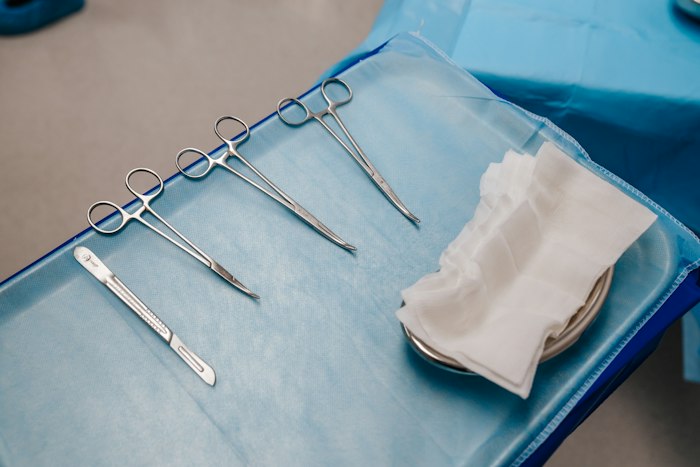
- Scalpel handles: a #3 scalpel handle suits the skin incision, while a #7 handle gives a slimmer grip for finer work.
- Dissecting scissors: curved Metzenbaum scissors with tungsten carbide edges handle fine dissection.
- Heavier scissors: curved Mayo SuperCut scissors or Mayo-Stille scissors suit tougher tissue.
- Tissue forceps: Adson-Brown tissue forceps hold skin edges with less crushing, and DeBakey forceps are a gentle option for deeper tissue.
Abdominoplasty instruments for retraction and exposure
Good exposure under a long flap is the hardest part of the tray to get right. Retractors made for the abdomen save your assistant a lot of effort.
- Abdominal flap retractor: the Saldanha abdominal retractor comes with 4 or 8 prongs and fiber optic options.
- Offset prong retractor: the Yancoskie abdominoplasty retractor has six offset sharp prongs for lifting the flap.
- Deep retractor: a Deaver retractor with fiber optic lights the far end of the dissection.
- Self-retaining retractor: a Weitlaner retractor holds smaller openings without an extra pair of hands.
- Light source: fiber optic retractors need a fiber optic LED light source.
- Skin hooks: Joseph double prong skin hooks lift the wound edges during closure.
Liposuction add-ons for a combined procedure
If you combine liposuction with the abdominoplasty, add these items to the tray. Remember that each cannula must match its handle fitting.
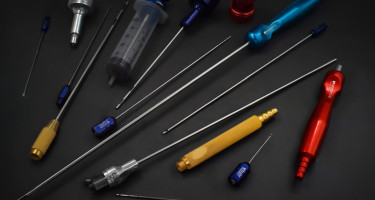
- Infiltration: a six spiral tumescent infiltration cannula spreads the fluid.
- Aspiration: the Mercedes and Triple Mercedes Luer lock cannulas are common choices.
- Handle: the Luer lock handle fits these cannulas.
For more detail, read our guide on how to choose a liposuction cannula.
Hemostasis, suction and draping
- Hemostats: Halsted mosquito forceps control small vessels.
- Suction: a Yankauer suction tube keeps the long field clear.
- Towel clamps: Backhaus towel clamps secure the drapes.
Plication and closure
- Needle holders: a Mayo-Hegar needle holder suits the heavier sutures used in fascial plication, while a Crile-Wood needle holder is a lighter option for layered closure.
- Combined needle holder: an Olsen-Hegar needle holder also cuts the suture, which saves a change of instrument.
Our guide on how to choose a needle holder compares these patterns.
Mini, full or combined: what changes on the tray
The core tray stays much the same across cases, but a few items shift with the plan.
- Mini abdominoplasty: the dissection is shorter, so a smaller retractor and standard length scissors are often enough.
- Full abdominoplasty: the flap reaches higher, so long retractors and good light become more important. For this reason, many surgeons prefer a fiber optic option.
- Lipoabdominoplasty: add the infiltration and aspiration items listed above, and check that every cannula matches its handle before the case begins.
In addition, if you often combine procedures, our guide to building a plastic surgery instrument set shows how to keep the core tray lean and add small packs for each case. As a result, you open only what you need.
Care between cases
Scissors and needle holders with tungsten carbide inserts last longer when you clean them right after use and keep them from knocking against heavier retractors. Our instrument care guide explains cleaning and autoclaving. To learn when carbide is worth the cost, read tungsten carbide vs stainless steel. For background on the procedure itself, see the American Society of Plastic Surgeons tummy tuck overview.
Order abdominoplasty instruments from Mosh Instruments
Browse our plastic surgery instruments and liposuction cannulas, or request a quote for a custom tray. Send us your checklist with the patterns and lengths you need, and we will quote a set made to it. All instruments are made in Sialkot, Pakistan, and carry a 3-month warranty.