
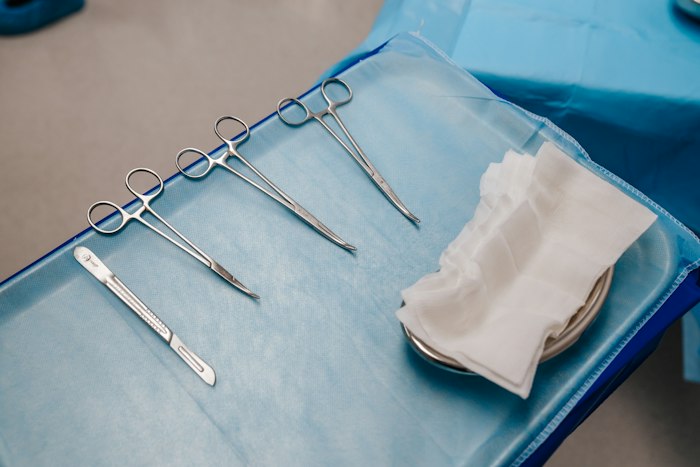

A surgical needle holder is the instrument a surgeon handles most often during closure. Small differences in jaw pattern, length and ratchet feel change how a suture line behaves. In fact, they matter far more than most buyers expect. This guide explains what to look for when you choose a surgical needle holder for a plastic or reconstructive surgery tray.
Match the jaw to the suture, not the procedure
Jaw geometry is the most important choice you make. A jaw that is too coarse crushes fine monofilament. On the other hand, a jaw that is too smooth lets heavier braided suture rotate mid-pass. So start with the suture sizes you use most, and then pick the jaw.
- Serrated jaws: the general-purpose choice. Cross-hatched or longitudinal serrations grip 3-0 to 6-0 sutures securely. They also tolerate years of repeated use.
- Smooth jaws: the right choice for microsurgery and very fine monofilament (7-0 and finer). Here, serrations would score the suture and create a failure point.
- Tungsten carbide inserts: hard-metal jaw faces, marked by gold rings. They hold their grip far longer than steel jaws. Therefore, they are worth the premium on any instrument in daily use.
For a deeper comparison, read our guide to tungsten carbide vs stainless steel instruments.
Choose the length from the depth of the wound
Pick the working length from how deep the wound is. After that, confirm it against the surgeon’s hand size. As a practical starting point:
- 10–12 cm: superficial and facial work, such as eyelid, nasal tip and small flap closure.
- 13–15 cm: general plastic surgery closure, hand surgery and most trunk work.
- 18 cm and above: deep cavity and abdominal closure, where the ring handles must clear the wound edge.
A holder that is too long forces the surgeon to grip the shanks. As a result, the ratchet stops working properly and the hand tires quickly.
Why ratchet feel matters in a surgical needle holder
A good ratchet engages with a clear, repeatable click. It also releases cleanly under thumb pressure alone. However, low-grade instruments often show two faults. First, the ratchet releases without warning under load. Second, it binds so hard that the instrument jumps on release. That jump is the classic way a needle gets flicked out of the field.
To test a sample, close it to each ratchet position. Then release it one-handed twenty times in a row. Any inconsistency will only get worse after autoclaving.
Common needle holder patterns and where they fit
- Crile-Wood: the workhorse. It has narrow, tapered jaws and suits 3-0 to 5-0 suture. If a tray carries one needle holder, it is usually this one.
- Mayo-Hegar: broader jaws than Crile-Wood. It suits heavier suture and fascial closure.
- Derf: a short 12 cm holder with a wide finger ring. Surgeons often choose it for facial and dermatological closure.
- Webster: delicate, with smooth or lightly serrated jaws for fine plastic surgery work.
- Ryder: long, fine jaws for vascular and nerve work with small-calibre suture.
- Castroviejo: a spring handle instead of rings. It suits microsurgery, where the hand should not open to release.
You can browse these patterns in our plastic surgery needle holders range. For true microsurgery, see our micro needle holders.
What to inspect when your instruments arrive
Whoever supplies your instruments, five quick checks catch nearly every defect:
- Hold the closed jaws up to a light. No light should pass between the jaw faces along their full length.
- Half-close the instrument and check the box joint. It should have no sideways play.
- Close it to the first ratchet and tap the shanks on a hard surface. The ratchet should not release.
- Examine the tungsten carbide inserts under magnification. Look for chips or lifted edges at the braze line.
- Check that the finish is an even satin or mirror polish. In particular, look for grinding marks near the joint, where corrosion starts.
Afterwards, keep every holder in good condition with a proper routine. Our guide to cleaning surgical instruments covers each step.
Building a surgical needle holder set
For a plastic surgery tray in regular use, start with a practical core:
- One Crile-Wood, 15 cm
- One Derf, 12 cm
- One Webster delicate
- One Ryder for fine work
Specify tungsten carbide inserts on all four. Add a Castroviejo only if your caseload includes true microsurgery. Otherwise, a spring handle gets in the way during routine closure. For the rest of the tray, see our guide to building a plastic surgery tray.
Frequently asked questions
What is a surgical needle holder used for?
It grips a curved suture needle firmly while the surgeon drives it through tissue. The ratchet then locks the needle in place between passes. You can read more about the instrument’s history on Wikipedia.
Are tungsten carbide needle holders worth the extra cost?
Yes, for any holder in daily use. The carbide jaws keep their grip much longer, so the needle slips less often.
What length of needle holder should I buy?
Most plastic surgery closure suits 13–15 cm. Choose 10–12 cm for facial work and 18 cm or more for deep cavities.
Are you building or replacing a set? Then send us your requirements, and we will quote each surgical needle holder against your specification.