
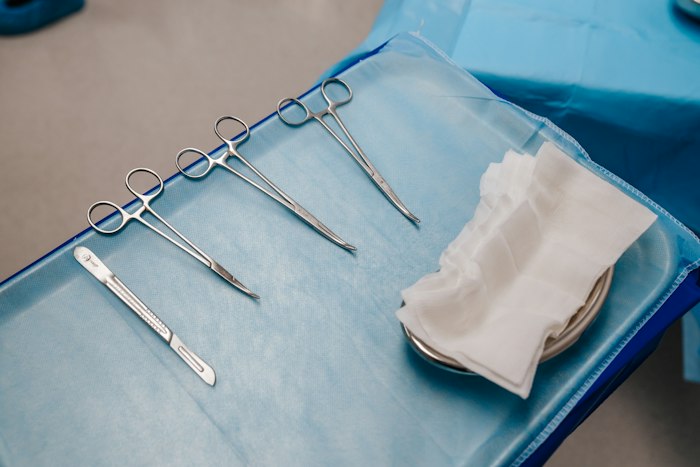
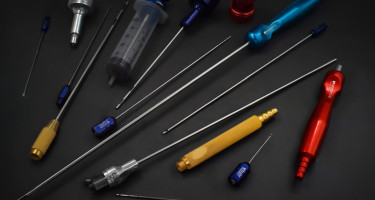

Scissors look simple. However, the pattern name on a catalogue line only tells you the blade shape and length. It says nothing about the two things that decide whether a pair still cuts cleanly on its five-hundredth use: the shear angle and the edge hardness. This guide explains the main types of surgical scissors on a plastic surgery tray, and what to specify for each.
Types of surgical scissors for dissection
- Metzenbaum: long shanks and short blades. These proportions let the surgeon work at depth, while the small blades spread tissue planes without cutting them. Curved blades are the default; straight is a specialist choice.
- Stevens tenotomy: fine blades with blunt or sharp tips, for delicate dissection around tendons and small structures. The thin ribbon-type blade flexes slightly, so it gives better feel in shallow planes.
- Freeman face-lift and Kaye: long, curved, blunt-tipped scissors shaped for undermining in rhytidectomy. Here the tip profile matters more than the edge, because a sharp tip in this plane is a risk.
You can compare these patterns in our plastic surgery scissors range.
Other types of surgical scissors: cutting and utility
- Iris: short, sharp/sharp, straight or curved. Originally an eye instrument, it is now the standard fine cutting scissor across plastic surgery. Choose sharp/sharp unless you need a blunt tip for safety near skin.
- Mayo: heavy blades for fascia and thick tissue. Use straight Mayo scissors for suture and dressings, and curved ones for tissue.
- Littler: curved, with an eye in the tip for passing suture. This hand-surgery pattern saves an instrument change.
- Spencer ligature: a small hooked blade that cuts stitches without lifting the knot. Therefore, it belongs on any tray that removes sutures.
Bandage and dressing scissors
Lister and Knowles patterns share an angled blade and a probe tip. As a result, the lower blade slides under a dressing without catching skin. Knowles is the finer of the two, so it works better on a small limb. In addition, a serrated lower blade stops gauze sliding forward during the cut. Specify serration for anything that will cut synthetic dressings.
Micro and spring scissors
Spring-handle scissors sit in the hand differently from ring-handled ones. The hand stays closed, and you open the blades by relaxing pressure rather than opening your fingers. Round handles also let you roll the instrument between finger and thumb, so you change the angle without moving the wrist.
For microsurgery, blade lengths of 8–15 mm are typical. Moreover, the blades should be honed rather than ground. See our micro scissors and our guide to choosing microsurgical instruments for more detail.
What separates good surgical scissors from poor ones
- Shear angle: the blades should meet at a single moving point, not along their whole length. Poor grinding makes the blades meet flat, so they push tissue ahead of the cut instead of shearing it.
- Screw tension: hold the scissors at the tip and let go. The blades should close under their own weight, yet show no sideways play. Loose scissors chew, while tight scissors tire the hand.
- Edge hardness: tungsten carbide inserts, marked by gold rings, hold an edge far longer on scissors that cut suture or mesh. On tissue-only dissectors, however, the benefit is smaller. Our tungsten carbide guide explains when the premium pays off.
- Tip alignment: when closed, the tips should meet exactly, with no crossing and no gap. A crossed tip snags on withdrawal.
A simple acceptance test
First, cut a single layer of thin latex or a 4×4 gauze at the very tip of the blades. Any scissors will cut at the middle; only a correctly ground pair cuts cleanly in the last two millimetres. Then repeat the test after the first autoclave cycle, because heat reveals grinding defects that a bench test misses.
Care that actually extends edge life
Scissors usually fail at the screw and at the tip. So lubricate the joint with instrument milk after every cleaning cycle, and never use mineral oil. Store scissors open, so the blades do not press against each other. Finally, keep tissue scissors and suture scissors apart, because cutting suture with a Metzenbaum ruins its edge fast. Our guide to cleaning surgical instruments covers the full routine.
Frequently asked questions
What are the main types of surgical scissors?
The main groups are dissecting scissors (Metzenbaum, Stevens, face-lift), cutting scissors (Iris, Mayo), suture scissors (Spencer, Littler), bandage scissors (Lister, Knowles) and micro spring scissors. You can read a general overview on Wikipedia.
What is the difference between Metzenbaum and Mayo scissors?
Metzenbaum scissors have long handles and short, fine blades for delicate dissection. In contrast, Mayo scissors have heavy blades for fascia, thick tissue and suture.
Why do some surgical scissors have gold handles?
Gold handles show that the blades carry tungsten carbide inserts. These keep a sharp edge much longer than plain steel.
We make all these types of surgical scissors in Sialkot, including tungsten carbide versions. Browse the scissors range or request a quote against your own specification.