
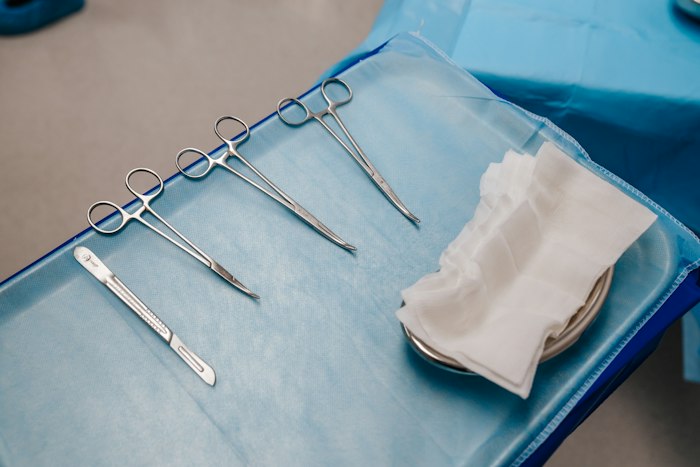
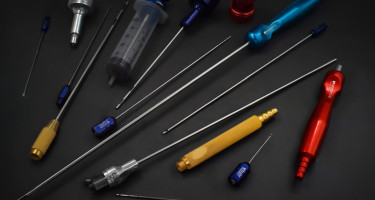

Microsurgical instruments are not simply smaller versions of standard ones. Their handle shape, balance point and spring return are all designed for a hand that stays still and works from the fingertips. So if you choose them by size alone, you get a set that looks right but works badly. This guide explains how to choose microsurgical instruments that actually perform under the microscope.
Spring handles on microsurgical instruments
You open a ring-handled instrument by opening your fingers. A spring-handled one, however, closes when you squeeze and opens itself when you relax. Under magnification, a two-millimetre hand movement is a large one. Therefore, that difference is decisive. Your hand never changes its grip, and you can roll the instrument between thumb and forefinger to change the blade angle without moving the wrist.
Two handle profiles are common:
- Round handles: allow continuous rotation between the fingers. Surgeons prefer them where the working angle keeps changing, such as vessel dissection.
- Flat handles: give a fixed, repeatable orientation. They suit work where the angle should not drift, such as suturing at a set approach.
Spring tension matters as much as the profile. If it is too stiff, the hand tires within minutes. If it is too light, on the other hand, the instrument does not hold. To test it, close and release thirty times in a row, and fatigue will show quickly.
Micro scissors
Blade lengths of 8–15 mm cover most microsurgical work. What separates a good pair from a poor one is that the blades are honed rather than ground. A honed edge shears cleanly at the very tip, and the tip is the only part of a micro scissor you ever use. Choose straight blades for cutting under direct vision and curved ones for dissection along a plane.
Keep micro scissors for tissue only. In fact, one pass through suture material ends their useful life. Browse our micro scissors range, or read our overview of the types of surgical scissors.
Micro needle holders
For 8-0 and finer monofilament, specify smooth jaws. Serrations that suit a 4-0 suture will score fine monofilament and create the exact point where it later breaks. In addition, curved jaws let you pick up the needle without rotating the wrist.
The ratchet question divides surgeons. A non-locking holder is faster, and it avoids the small jolt that a ratchet release sends to the tip. A locking one, by contrast, is more secure for needle transfer. For vessel work under high magnification, non-locking is the more common choice. See our micro needle holders and our full surgical needle holder guide.
Fine forceps for microsurgery
- Jeweller’s forceps: graded by tip fineness (#3, #5, #7 and so on). #5 is the general microsurgical default, while finer tips bend if they grip anything substantial.
- Tying forceps: a flat platform behind the tip lets you handle suture without crushing it. They are essential for micro-knot tying, because a jeweller’s forceps used for tying will cut the thread.
- Fine-toothed dressing and tissue forceps: for tissue edges, where a smooth tip would slip.
The tips should meet exactly, with no gap under light pressure, and they should not cross. So check every pair under magnification, not by eye. Our micro forceps range covers the common patterns.
Handling and storing microsurgical instruments
Most microsurgical instruments are ruined outside the operating field, not inside it. Fortunately, three rules prevent nearly all of that damage:
- Never let the tips touch anything hard. That means no tray, no other instrument and no sink. Silicone tip guards during cleaning and sterilization are essential.
- Store them in a dedicated micro case with individual channels. Loose in a general tray, a set can be destroyed within weeks.
- Clean them separately. Ultrasonic cleaning is fine and even preferable, but only in a rack that holds each instrument apart.
Finally, inspect every instrument under magnification after each reprocessing cycle. A bent tip is invisible at arm’s length, yet obvious at 10x. Our guide to cleaning surgical instruments covers the full reprocessing routine.
A minimal starting set
For a surgeon starting microsurgical work, a workable core set is:
- One straight and one curved micro spring scissor
- One curved, non-locking micro needle holder with smooth jaws
- One pair of #5 jeweller’s forceps
- One pair of tying forceps
Then add a vessel dilator and approximating clamps only when your caseload requires them.
Frequently asked questions
What are microsurgical instruments used for?
They are used for surgery under an operating microscope, such as vessel, nerve and hand repair. For background, see the microsurgery article on Wikipedia.
Why do microsurgical instruments have spring handles?
Spring handles open by themselves when you relax your grip. As a result, the hand stays still and the tip stays steady under magnification.
Should micro needle holders have serrated or smooth jaws?
Smooth jaws are best for 8-0 and finer monofilament, because serrations can damage the suture.
We make micro scissors, micro needle holders and fine forceps in Sialkot. Browse our micro instruments range, or tell us your specification and we will quote against it.