
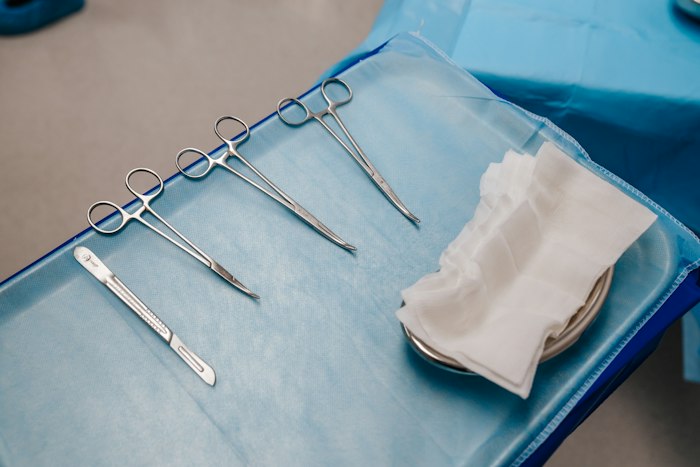
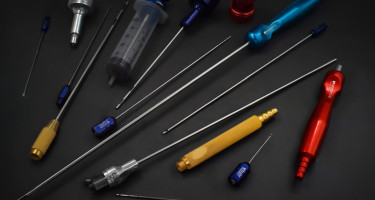

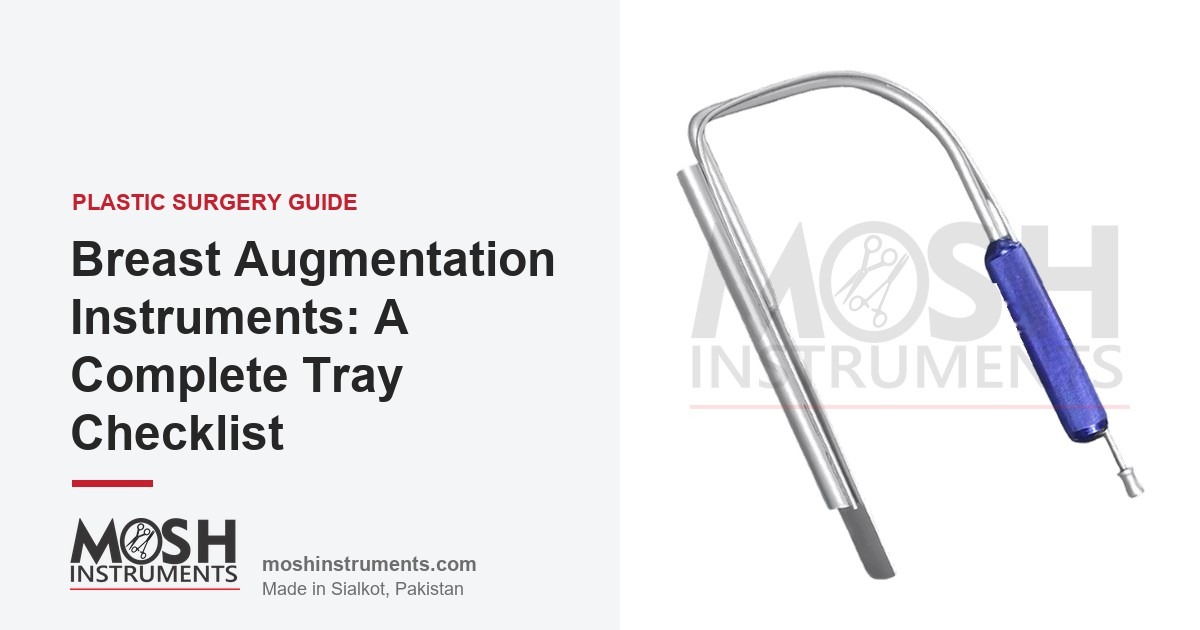
Breast augmentation depends on a clean, precise implant pocket and a clear view of it. The right tray makes both easier. This checklist of breast augmentation instruments groups the patterns by step, from marking to closure. Use it to build a new tray, to audit the one you have, or to plan an endoscopic setup.
How to use this list of breast augmentation instruments
Your incision and pocket plane decide much of the tray. Inframammary, periareolar and transaxillary approaches each need different lengths and angles. The American Society of Plastic Surgeons gives a good overview of these options. So, first mark the patterns you use in every case. Next, move the approach-specific instruments into small add-on packs. Finally, note the blade widths and lengths you prefer, so a supplier can match them exactly.
Marking and measuring
- Skin marker and ruler: for the midline, the inframammary fold and the implant base width.
- Areola markers: a Freeman areola marker or a Grossman cookie-cutter marker gives a symmetrical areola when you combine augmentation with a lift.
- Caliper: for nipple-to-fold distance and symmetry checks.
Incision and initial dissection
- Scalpel handle #3: with #15 and #10 blades.
- Fine scissors: for the subcutaneous layer and the fascia.
- Skin hooks and small rakes: for retraction at the incision.
- Insulated forceps: for bipolar or monopolar haemostasis along the way.
Pocket dissection
This is the core of the tray. In general, you need long dissectors that reach the far edge of the pocket without a large incision.
- Breast dissectors: the McCollum-Dingman breast dissector releases tissue bluntly at the pocket edges. There is also a four-piece spatula set for different widths.
- Tebbetts dissector: the paddle-shaped Tebbetts dissector sweeps the pocket evenly and helps define the fold.
- Breast elevator: a long Mammostat breast elevator lifts the gland or muscle during deep dissection.
Retraction and lighting
A narrow incision leads to a deep pocket, so light matters as much as retraction. For this reason, fiber optic retractors are standard on many trays.
- Fiber optic retractors: the Tebbetts retractor with fiber optic and suction lights the pocket and clears smoke at the same time. A C-circular retractor and a fiber optic Deaver retractor add options for different pocket shapes.
- Light source: a fiber optic LED light source powers the lit retractors.
- Double-ended retractors: a Tebbetts double-end retractor or an Epstein breast retractor holds the edges while you check the pocket.
- Semi-malleable spatula: the Tebbetts spatula retractor can be shaped to the chest wall.
Endoscopic breast augmentation instruments
Transaxillary and endoscope-assisted cases need their own patterns. In addition to a 10mm endoscope and a camera, the tray typically holds:
- Endoscopic retractor: the Emory endoscopic retractor has a 10mm scope guide, a locking screw and a smoke evacuation channel.
- Long dissectors and insulated instruments: for releasing the pectoralis origin under direct vision.
- Retractors with long blades: such as the Sculpo breast retractor, 180 x 25mm.
Implant placement and closure
- Sizers: to confirm volume and projection before the final implant.
- Insertion aids: a funnel and a no-touch technique reduce contamination.
- Needle holders and forceps: a fine needle holder for layered closure. Our needle holder guide covers the options.
Inspect and care for the tray
Long breast augmentation instruments flex and wear in specific places. Therefore, check them after every reprocessing cycle:
- Fiber optic retractors: look for broken fibers. Hold the light cable to the light and check that the tip shines evenly.
- Dissectors: check that tips are smooth, with no burrs that could damage tissue or an implant shell.
- Suction channels: flush and brush them, because blood and fat block the lumen.
- Insulated instruments: test the insulation for cracks before each case.
Our instrument care guide explains cleaning, lubrication and autoclaving in more detail.
Buy a complete set or build your own
A complete set saves time when you equip a new theatre. For instance, our breast augmentation instrument set covers the core steps on this list. On the other hand, you may already own part of a tray. In that case, order only the missing breast augmentation instruments, such as lit retractors or an endoscopic retractor.
We also build custom sets. Send us your checklist with the patterns, lengths and blade widths you need, and we will quote a set made to it. All instruments are made in medical-grade stainless steel in Sialkot, Pakistan, and they carry a 3-month warranty.
Order breast augmentation instruments from Mosh Instruments
Browse our breast dissectors and fiber optic retractors and plastic surgery sets, or request a quote for a custom tray. We ship worldwide and offer OEM manufacturing, private labeling and wholesale pricing.