

Eyelid surgery is fine work on the thinnest skin of the body, so blepharoplasty instruments must be small, sharp and gentle. This checklist groups the blepharoplasty instruments you need by step, from marking to closure, for both upper and lower lid surgery. Use it to build a new eyelid tray, to audit the one you have, or to plan an add-on set for a facial practice. For a patient-level overview of the operation, see the American Society of Plastic Surgeons guide to eyelid surgery.
How to use this list of blepharoplasty instruments
Upper and lower blepharoplasty share a core tray, but the approach changes the details. An upper lid excision needs fine scissors and precise marking. A transconjunctival lower lid approach needs good lid retraction and delicate fat handling. So, first mark the patterns you use in every case. Next, move the approach-specific instruments into a small add-on pack. Finally, note your preferred lengths and tip styles, so a supplier can match them exactly.
Marking and measuring
- Caliper: a Castroviejo caliper measures the skin to remove and the distance from the lash line, so both sides stay symmetrical.
- Skin marker and pinch test: mark the crease and the excess skin, then confirm with fine forceps that the lids still close fully.
Blepharoplasty instruments for skin and muscle excision
The scissors are the heart of any eyelid tray. They must be short, curved and very sharp at the tips. In addition, tungsten carbide blades keep their edge longer and cut thin skin cleanly instead of chewing it.
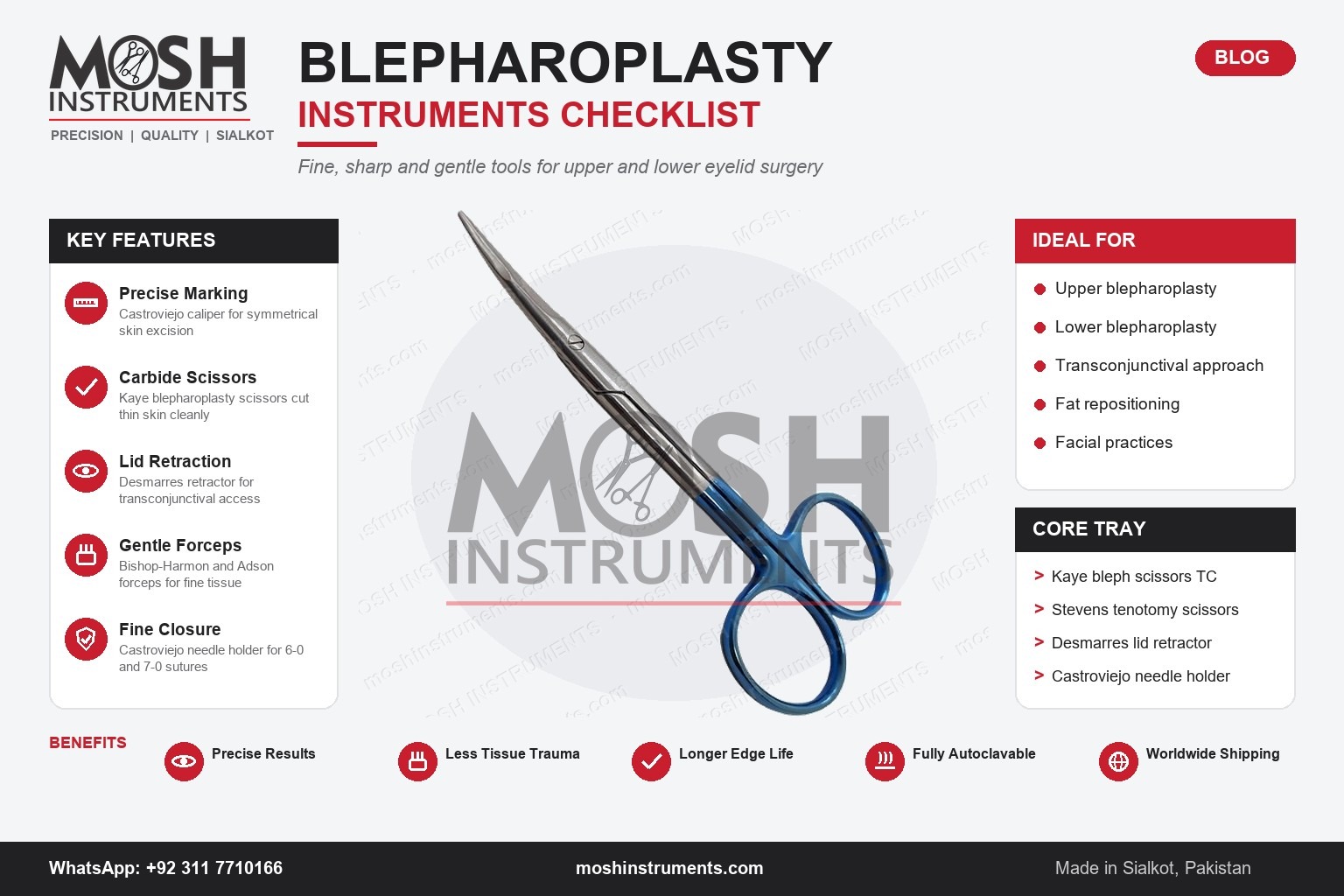
- Kaye blepharoplasty scissors: the Kaye blepharoplasty scissors, tungsten carbide are a standard for excising the skin and orbicularis strip. The ribbon-finger version suits surgeons who prefer a lighter, spring-like feel.
- Curved blepharoplasty scissors: the curved blepharoplasty scissors TC, 4-1/2″ give a slightly longer reach along the lid.
- Stevens tenotomy scissors: the Stevens tenotomy scissors TC are ideal for blunt spreading and fine dissection around the septum.
Retraction and exposure
- Lid retractor: the Desmarres lid retractor everts and protects the lid, which is essential in the transconjunctival approach. It comes in 10, 12 and 14mm, with an insulated-shaft option for use with cautery.
- Skin hooks: fine Kleinert-Kutz skin hooks hold the skin edges without crushing them.
Fat handling and fine forceps
Fat removal or repositioning needs gentle grasping, so forceps with fine, even teeth matter more than force.
- Bishop-Harmon forceps: the Bishop-Harmon iris tissue forceps hold thin lid skin and fat pads delicately.
- Adson forceps: Adson forceps TC, 1×2 teeth give a secure hold for the muscle layer.
- Iris scissors: fine curved iris scissors TC trim fat pads precisely.
Closure
- Fine needle holders: a Castroviejo needle holder TC or a Webster needle holder handle 6-0 and 7-0 sutures without damaging them. Our needle holder guide covers the options.
- Suture forceps: Castroviejo suture forceps have a tying platform for fast, neat knots.
- Micro scissors: Castroviejo micro scissors TC cut fine sutures cleanly.
Inspect and care for your blepharoplasty instruments
Eyelid instruments are small and delicate, so damage shows quickly. Therefore, check them after every reprocessing cycle:
- Scissors: test the cut on thin latex or tissue paper right to the tips. Fine blades should cut cleanly, not fold the material.
- Forceps: close them under light and check that the tips meet evenly and the teeth are not bent.
- Needle holders: check the jaws for wear and the ratchet for a firm, even click.
- Storage: keep fine tips in a protected rack or silicone mat, never loose in a tray.
Our instrument care guide explains cleaning, lubrication and autoclaving in more detail, and our tungsten carbide guide shows when carbide inserts are worth it. For more on fine instruments, see our micro surgery instruments guide.
Buy a complete set or build your own
If you are equipping a new practice, a ready-made set saves time. For instance, our blepharoplasty surgery set (14 pcs) covers the core tray, and the advanced blepharoplasty set (31 pcs) adds the fine instruments for lower lid work. On the other hand, you may already own part of a tray. In that case, order only the missing patterns, such as a Desmarres retractor or carbide eyelid scissors.
We also build custom sets. Send us your checklist with the patterns, lengths and tip styles you need, and we will quote a set made to it. All instruments are made in medical-grade German stainless steel and tungsten carbide in Sialkot, Pakistan, and they carry a 3-month warranty. For the rest of the face, see our facelift instruments checklist and rhinoplasty instruments checklist.
Order blepharoplasty instruments from Mosh Instruments
Browse our plastic surgery scissors and hooks and retractors, or request a quote for a custom eyelid surgery tray. We ship worldwide and offer OEM manufacturing, private labeling and wholesale pricing.