
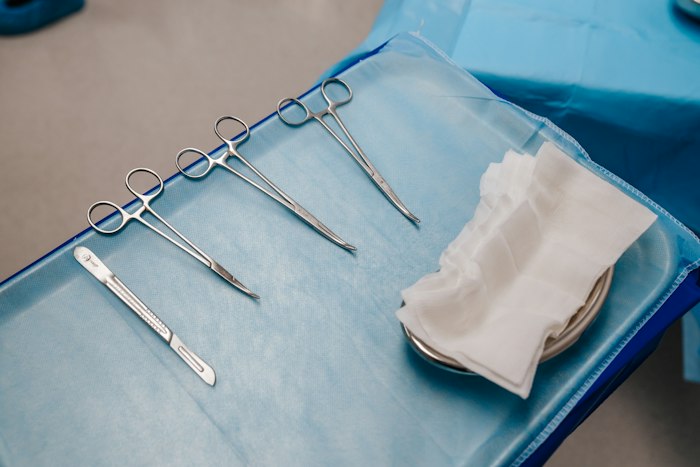

A facelift is long, delicate work under thin skin flaps, so every instrument on the tray has to cut cleanly, hold gently and reach far. This checklist of facelift instruments groups the patterns by step, from marking to closure. Use it to build a new tray, to audit the one you have, or to plan a deep plane or SMAS setup. For a patient-level overview of the operation, see the American Society of Plastic Surgeons guide to facelift surgery.
How to use this list of facelift instruments
Your technique decides much of the tray. A short-scar lift, a SMAS plication and a deep plane lift each need different scissor lengths and tip shapes. So, first mark the patterns you use in every case. Next, move the technique-specific instruments, such as a neck pack or fat grafting cannulas, into small add-on sets. Finally, note the lengths and tip styles you prefer, so a supplier can match them exactly.
Marking and infiltration
- Skin marker and ruler: for the incision line around the ear and into the hairline.
- Marker forceps: the D’Assumpcao face lift marker forceps mark the exact amount of skin to remove after redraping, on both sides.
- Infiltration cannula: a Schwarcz facelift infiltrator spreads tumescent fluid evenly under the flap, which helps both haemostasis and dissection.
Facelift instruments for skin flap elevation
This is where the right scissors matter most. Facelift scissors are long, with blunt, slightly curved tips that spread and cut in the subcutaneous plane. In addition, serrated tungsten carbide blades grip the tissue, so they do not slip on fat.
- Kaye face lift scissors: the Kaye face lift scissors, TC serrated are a standard for undermining the cheek and neck flaps.
- Gorney face lift scissors: the Gorney face lift scissors TC have a longer reach for wide undermining.
- Freeman-Gorney SuperCut: the Freeman-Gorney SuperCut scissors have one razor-sharp blade for a very clean cut through the flap.
- Rees and Stille patterns: the Rees Stille face lift scissors and the Aston Stille face lift scissors suit surgeons who like a heavier, stiffer blade.
SMAS and deep plane dissection
- Spatula-tip scissors: the Trepsat facelift dissection scissors have blunt spatula tips from 5 to 20mm, for safe blunt release under the SMAS.
- Fine dissecting scissors: a Metzenbaum SuperCut or Solz face lift scissors for the SMAS flap edges and the retaining ligaments.
- Forceps: Adson-Brown tissue forceps hold the flap gently, with many fine teeth that spread the pressure.
Retraction and lighting
A facelift pocket is wide but shallow, and the far end is hard to see. For this reason, many trays include at least one lit retractor.
- Face lift retractor: the Freeman face lift retractor has offset prongs that lift the flap without blocking your view.
- Rakes and skin hooks: a Freeman flap rake, Joseph double skin hooks and Kleinert-Kutz skin hooks control the flap edges.
- Fiber optic retractor: the Aston submental retractor with fiber optics lights the deep neck through a small submental incision. A fiber optic LED light source powers it.
Neck lift and platysma work
- Platysma scissors: the Platysma Gorney scissors TC are long and angled for platysmaplasty through the submental incision.
- Neck liposuction: small cannulas from a facial liposuction cannula set refine the jawline and submental fat. Our liposuction cannula guide explains tip and diameter choices.
Fat grafting add-on
Many surgeons restore volume during the lift. If you do, add a small fat grafting pack: a Tonnard superficial injector for fine lines and a nano fat transfer kit for skin quality.
Closure
- Fine needle holders: a Webster needle holder or a Castroviejo needle holder TC for the fine skin sutures around the ear. Our needle holder guide covers the options.
- Suture scissors and fine forceps: for the final layer and the earlobe inset.
Inspect and care for your facelift instruments
Facelift scissors lose their edge before anything else on the tray. Therefore, check them after every reprocessing cycle:
- Scissors: test the cut on thin latex or tissue paper along the full blade. Serrated TC blades should grip, not chew.
- Tips: check that blunt and spatula tips are smooth, with no burrs that could tear a thin flap.
- Fiber optic retractors: hold the light cable to the light and check that the blade shines evenly.
- Cannulas: flush and brush them, because fat blocks the ports.
Our instrument care guide explains cleaning, lubrication and autoclaving in more detail, and our tungsten carbide guide shows when carbide inserts are worth it.
Buy a complete set or build your own
If you are equipping a new theatre, start with the core facelift instruments on this list, for instance the Freeman-Gorney facelift scissors set. On the other hand, you may already own part of a tray. In that case, order only the missing patterns, such as spatula-tip scissors or a lit submental retractor.
We also build custom sets. Send us your checklist with the patterns, lengths and tip styles you need, and we will quote a set made to it. All instruments are made in medical-grade German stainless steel and tungsten carbide in Sialkot, Pakistan, and they carry a 3-month warranty. For the rest of the face, see our rhinoplasty instruments checklist.
Order facelift instruments from Mosh Instruments
Browse our plastic surgery scissors and hooks and retractors, or request a quote for a custom facelift tray. We ship worldwide and offer OEM manufacturing, private labeling and wholesale pricing.