
The Aufricht nasal retractor is one of the most used instruments in rhinoplasty. It lifts the skin and soft tissue envelope off the nasal dorsum, so the surgeon gets a clear view of the bony and cartilaginous vault. This guide explains its key features, where it is used, the four types available and how to choose the right one for your tray.
What is an Aufricht nasal retractor?
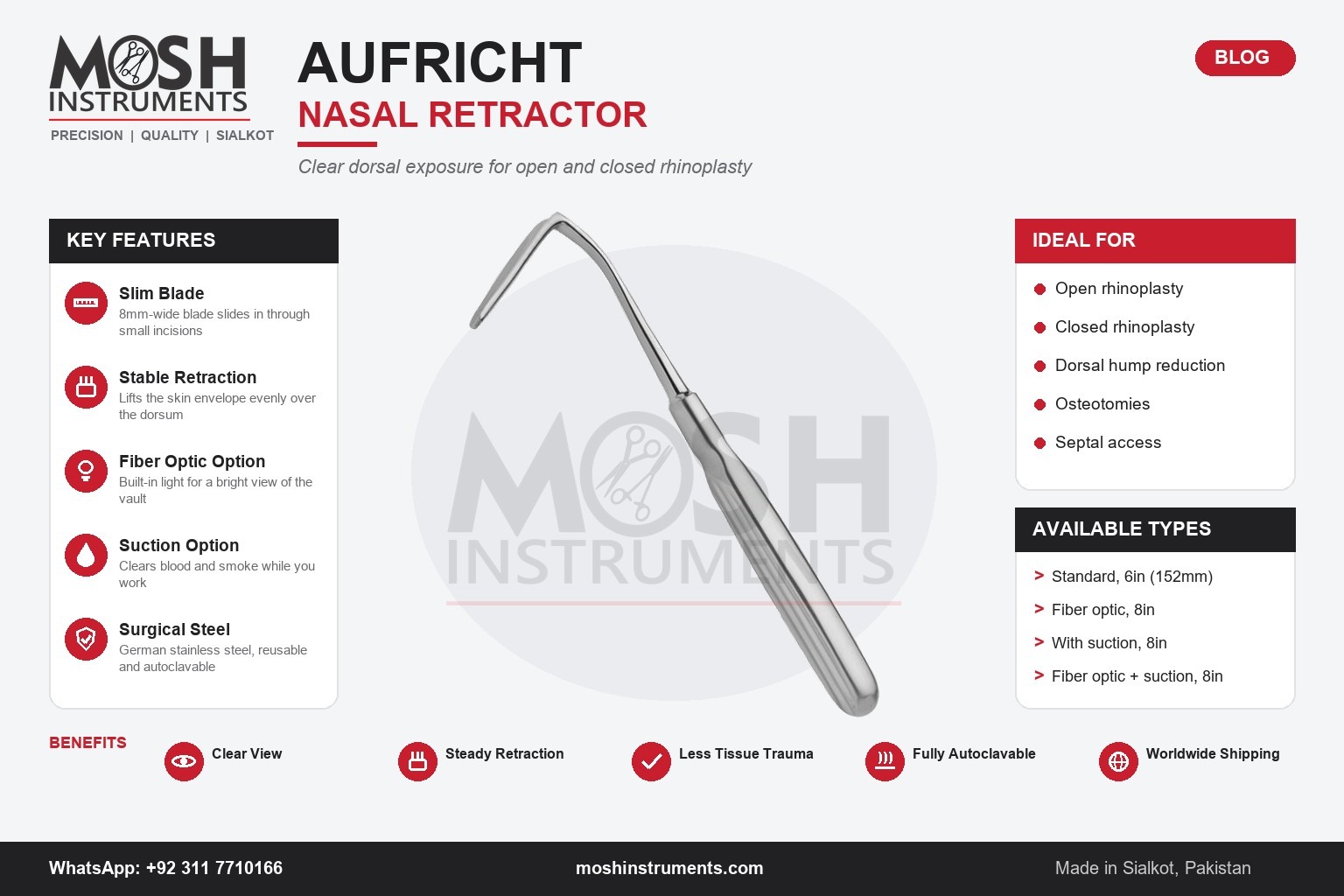
The instrument has a handle and a slim, angled blade. The blade slides under the skin through the rhinoplasty incision and lifts the tissue upward. As a result, the dorsum is exposed for hump reduction, rasping and osteotomies. Because the blade is narrow, it works through small incisions in both open and closed approaches.
Key features of the Aufricht nasal retractor
- Slim blade: an 8mm-wide blade enters through small incisions and sits flat under the skin.
- Stable retraction: the angled blade lifts the skin envelope evenly, so the assistant can hold a steady view with little effort.
- Fiber optic option: an illuminated blade lights the vault directly. Therefore, you see deep structures without a headlight shadow.
- Suction option: an integrated suction tube clears blood and smoke from under the blade while you work.
- Surgical steel: medical-grade German stainless steel, reusable and fully autoclavable.
Where it is used
Surgeons use this retractor in most procedures that expose the nasal dorsum. For a patient-level overview of the operation, see the American Society of Plastic Surgeons guide to rhinoplasty.
- Open rhinoplasty: lifts the skin flap after the transcolumellar incision.
- Closed rhinoplasty: creates a working space through intercartilaginous incisions.
- Dorsal hump reduction: holds the envelope up while you use a rasp or an osteotome on the hump.
- Osteotomies: keeps the soft tissue protected during medial and lateral cuts.
- Septal access: improves exposure of the septum from above.
For the full tray, see our rhinoplasty instruments checklist.
Available types
We make four versions. Each one suits a different surgical style and budget.
- Standard, 6in (152mm): the standard Aufricht nasal retractor with an 8mm blade. Simple, light and affordable for every tray.
- Fiber optic, 8in: the fiber optic Aufricht retractor adds built-in light for a bright view of the vault.
- With suction, 8in: the Aufricht retractor with suction keeps the field dry during hump work.
- Fiber optic and suction, 8in: the combined fiber optic and suction model gives light and suction in one blade.
How to choose the right one
First, consider your lighting. If you already use a strong headlight, the standard model is often enough. However, a fiber optic blade helps a great deal in deep, closed approaches. Next, think about bleeding and smoke. If you use energy devices on the dorsum, a suction model saves time. Finally, check compatibility. Illuminated retractors need a light cable and a fiber optic light source.
Many surgeons keep two on the tray: a standard 6in retractor for routine exposure and an illuminated one for difficult cases.
Benefits for the surgical team
- Clear view: better exposure means more precise work on the dorsum.
- Steady retraction: less fatigue for the assistant during long cases.
- Less tissue trauma: a smooth, slim blade spreads the pressure evenly.
- Fully autoclavable: it goes through standard sterilization cycles.
- Worldwide shipping: we ship from Sialkot to clinics around the world.
Care and sterilization
Rinse the blade straight after use. For suction models, flush the tube with water and then clean it with a brush, because dried blood blocks the lumen. Check fiber optic blades for broken fibers by holding the cable to the light. Then dry, inspect and autoclave. Our instrument care guide explains each step in detail.
Order an Aufricht nasal retractor from Mosh Instruments
All our retractors are made in medical-grade stainless steel in Sialkot, Pakistan, and they carry a 3-month warranty. Browse our ENT instruments, or request a quote for wholesale, OEM and private label orders. We ship worldwide.