
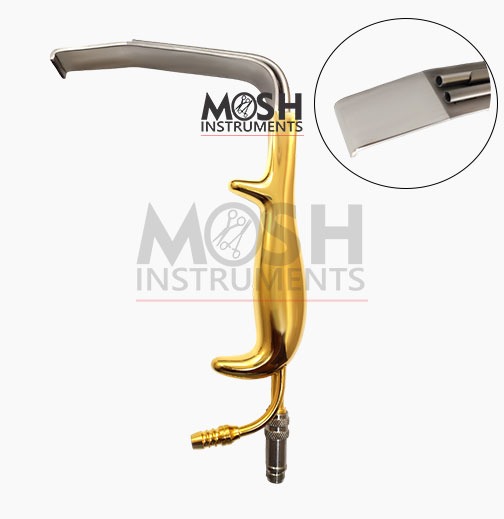
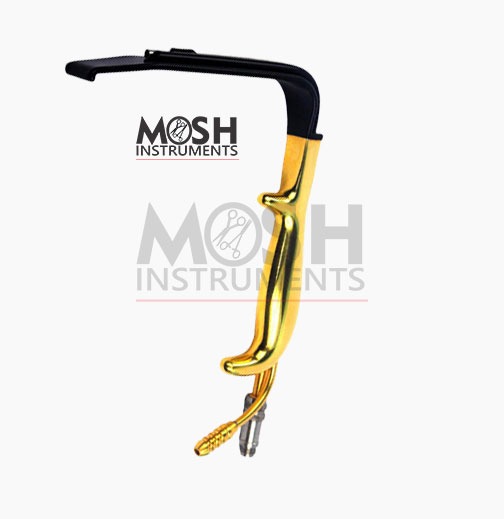
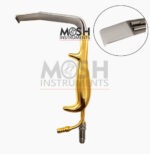
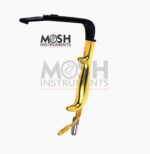
The Tebbetts fiber optic breast retractor lights the implant pocket and clears fluid while it retracts. It comes in many blade sizes, with a standard or insulated tip.
A fiber optic guide shines into the deep pocket, while a suction tube removes blood and smoke. As a result, you get a bright, clear view through a small incision. In addition, the insulated tip suits work with electrocautery.
Fiber optic breast retractor Features
- Fiber optic guide: gives bright, shadow-free light in the pocket.
- Built-in suction: removes blood, fluid and smoke.
- Many blade sizes: from 70mm to 220mm long and 16mm to 36mm wide.
- Insulated tip option: for safer use near electrocautery.
- German stainless steel: resists corrosion through many autoclave cycles.
Clinical Applications
- Breast augmentation
- Implant pocket dissection
- Breast reconstruction
- Breast revision surgery
- Endoscopic-assisted breast surgery
Technical Specifications
| Pattern | Tebbetts, fiber optic with suction |
| Blade sizes | 70 x 25mm up to 220 x 27mm (see options) |
| Tip | Standard or insulated |
| Material | German surgical stainless steel |
| Finish | Satin |
| Sterilization | Autoclavable, reusable |
Cleaning and Sterilization
Clean the instrument soon after each case. First, flush the suction channel with an enzymatic cleaner. Then brush the channel and wipe both ends of the light guide. After that, rinse and dry it fully. Finally, autoclave it with your standard steam cycle. Also, check the light output before each case.
Quality, Warranty and OEM Supply
We make every instrument at our workshop in Sialkot, Pakistan. Before dispatch, our team checks each piece for finish, fit and function. We supply it non-sterile, so sterilize it before first use. In addition, a 3-month warranty covers material and manufacturing defects. We also offer OEM manufacturing, private labeling and wholesale supply. Browse our full range of breast dissectors and fiber optic retractors.
Fiber optic breast retractor FAQs
Why use a fiber optic breast retractor?
It lights the deep implant pocket directly. So you can see clearly through a small incision.
What is the insulated tip for?
The insulated tip helps when you use electrocautery near the blade.
Which blade size should I choose?
Shorter blades suit periareolar access. However, longer blades suit inframammary and transaxillary access.

Reviews
There are no reviews yet.