
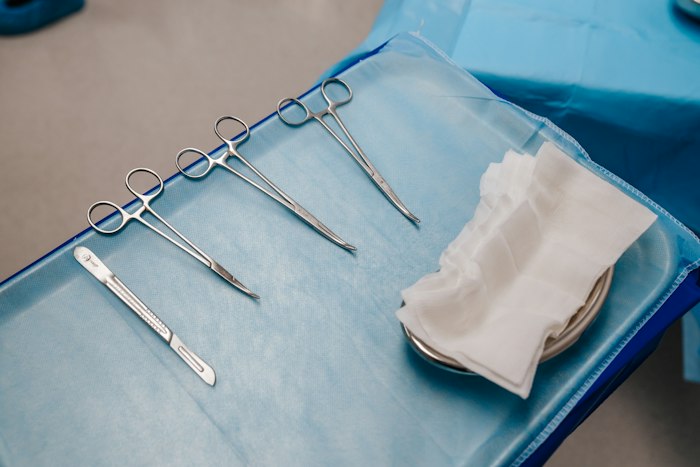
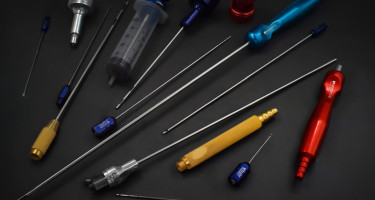


A plastic surgery tray tends to grow over time. Patterns get added after a difficult case, duplicated when one goes for repair, and then never removed. The result is a heavy set, a longer count and more instruments to reprocess than the caseload needs. This guide outlines what a core plastic surgery tray should hold, and what you can keep in smaller add-on packs.
The principle: one core plastic surgery tray, several small packs
Sterilizing twelve instruments you did not use costs reprocessing time, wrap and wear. So build a lean core tray that covers about eighty per cent of cases. Then support it with small procedure-specific packs that you open only when needed. As a result, the set is cheaper to run and faster to count.
Cutting and dissection on a plastic surgery tray
- Scalpel handle: #3 for fine blades, or #4 if you use heavier blades.
- Metzenbaum scissors, curved, 14–18 cm: the primary dissector.
- Iris scissors, sharp/sharp, straight and curved: for fine cutting, especially near skin edges.
- Stevens tenotomy scissors, curved: especially for delicate dissection around small structures.
- Mayo scissors, straight: for suture and dressings only, never tissue.
Keep tissue scissors and suture scissors easy to tell apart. For example, colour-coded or marked rings are worth the small cost. Our guide to the types of surgical scissors explains each pattern in detail.
Grasping
- Adson forceps with 1×2 teeth: the standard skin forceps. Tungsten carbide inserts are worthwhile here, because the teeth wear.
- Adson forceps, serrated: also for handling tissue, but without teeth marks.
- Brown-Adson forceps: multiple fine teeth spread the grip over a longer edge.
- DeBakey forceps: atraumatic, for vessels and delicate tissue.
- Plain dressing forceps: finally, for packing and dressings.
See our tissue and dressing forceps for these patterns.
Haemostasis
- Halstead mosquito forceps, curved: six to eight. This is the pattern trays most often run short of.
- Crile or Kelly forceps, curved: four.
- Allis tissue forceps: in addition, two for holding tissue that you will excise.
Suturing instruments for the plastic surgery tray
- Crile-Wood needle holder, 15 cm, tungsten carbide: the workhorse.
- Derf needle holder, 12 cm: for facial and dermatological closure.
- Webster needle holder, delicate: especially for fine work.
- Suture scissors: a dedicated pair, ideally the Spencer ligature pattern.
Specify tungsten carbide on every needle holder in daily use. In fact, this is the clearest case in the whole tray for paying the premium. Our surgical needle holder guide and tungsten carbide guide explain why.
Retraction and exposure
- Skin hooks, single and double prong: two of each.
- Senn retractor, sharp and blunt ends: two.
- Army-Navy or Langenbeck retractor: a pair, especially for deeper exposure.
- Self-retaining retractor: one Weitlaner or similar, sized to the field.
Browse our skin hooks and retractors and self retaining retractors.
Measuring and marking
A flexible ruler, a caliper and a skin marker cost very little. Yet they are consistently the items a plastic surgery tray lacks. In aesthetic work, symmetry is the outcome people judge, so these tools are essential. See our surgical marking instruments.
Add-on packs to keep outside the plastic surgery tray
- Facial and rhinoplasty: fine osteotomes, rasps, nasal specula, and Freeman or Kaye undermining scissors.
- Hand: Littler scissors, a fine bone rongeur, small elevators and tendon-passing instruments.
- Micro: spring scissors, a micro needle holder, and jeweller’s and tying forceps. Keep them in a dedicated micro case rather than loose in the tray, as our microsurgical instruments guide explains.
- Breast: long retractors, breast dissectors and fibre-optic retractors.
Practical notes on specifying a set
- Buy duplicates of what fails first. Mosquito and Adson forceps get lost and bent, while needle holders go away for re-insertion. So one spare of each stops a single instrument making a tray unusable.
- Match lengths to your real depth of field, not to a catalogue default. A 15 cm needle holder suits most plastic surgery, whereas an 18 cm one is clumsy in a facial case.
- Standardise across trays. Use the same pattern, length and finish everywhere. Otherwise, mixed sets slow the count and make wear impossible to track.
- Record the specification. A written list of patterns, lengths and jaw types turns re-ordering into a single email.
Frequently asked questions
What instruments are in a basic plastic surgery tray?
A core tray holds a scalpel handle, dissecting and cutting scissors, toothed and smooth forceps, mosquito and Crile forceps, needle holders, skin hooks, retractors and marking tools. For a general overview of the specialty, see plastic surgery on Wikipedia.
How many mosquito forceps should a tray have?
Six to eight curved Halstead mosquito forceps is a practical number, because trays most often run short of this pattern.
Should every instrument have tungsten carbide inserts?
No. Put carbide on needle holders and suture scissors in daily use, and on Adson forceps with teeth. Everything else works well in plain stainless steel.
We make every pattern above in Sialkot, in both steel and tungsten carbide. You can also choose one of our ready-made plastic surgery instrument sets. Or send us your own list, and we will price a complete plastic surgery tray item by item.