
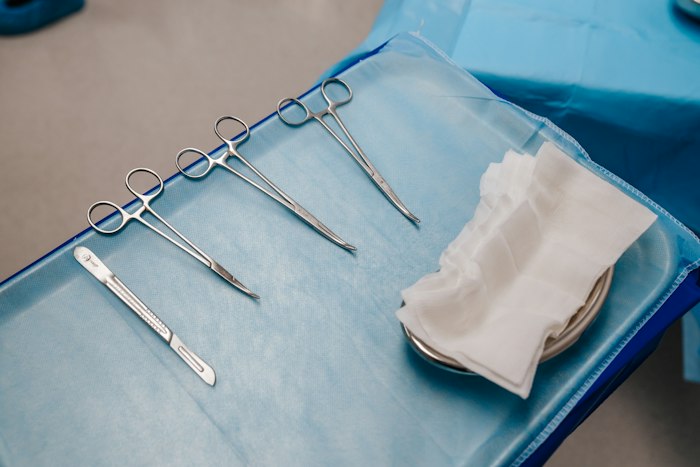

Pick up two needle holders of the same pattern and length. Usually, the more expensive one has gold-plated finger rings. That gold is not decoration. Instead, it is an industry signal that the jaws carry tungsten carbide inserts. This guide explains what tungsten carbide instruments actually do, and when they are worth the extra cost.
What makes tungsten carbide instruments different
A conventional instrument has its gripping or cutting surface machined straight into the stainless steel body. In contrast, tungsten carbide instruments have a small plate of sintered carbide brazed into a recess in each jaw. The carbide is roughly three times as hard as hardened stainless steel. As a result, it holds a fine serration or a honed edge far longer under repeated use. You can read more about the material itself on Wikipedia.
The colour code is simple and almost universal:
- Gold rings or gold handles: tungsten carbide inserts.
- Plain steel handles: steel jaws or edges.
- Black handles: on scissors, this usually means a super-cut edge. On other instruments, check the maker’s own key.
Where tungsten carbide instruments pay for themselves
- Needle holders in daily use: this is the strongest case. A steel jaw loses its grip on the needle slowly and unpredictably. A carbide jaw, however, holds until the insert is visibly worn, which takes years. Needle slip mid-pass costs time and also creates a sharps risk.
- Scissors that cut suture, mesh or synthetics: synthetic materials dull steel edges quickly. Carbide inserts, therefore, stretch the time between re-sharpening a great deal.
- Instruments you re-sharpen: carbide inserts can be re-ground several times. When they finally wear out, a good maker can braze new inserts into the same body. This is far cheaper than a new instrument.
For help choosing the right pattern, see our surgical needle holder guide and our overview of the types of surgical scissors.
Where carbide is not worth it
- Tissue forceps and retractors: no cutting or gripping edge does the work. So the extra hardness has nothing to act on.
- Instruments used rarely: if a pattern leaves the tray only a few times a year, a steel jaw will outlast its service life anyway.
- Very fine micro needle holders: for 8-0 and finer monofilament, smooth steel jaws are better, precisely because they do not bite into the suture.
How to inspect tungsten carbide inserts
Carbide inserts fail at the braze line, not in the middle. So look closely at the border between the carbide and the surrounding steel under magnification. It should be one continuous, even line, with no gaps, no porosity and no lifted corners. Otherwise, a lifted edge traps protein, resists cleaning and eventually breaks off in use.
Two more checks are worth doing when an order arrives:
- Hold the closed jaws up to a light. The carbide faces should meet flush along their whole length. A gap means the inserts sit unevenly.
- Look for discoloration around the braze. Heat damage during brazing softens the nearby steel, and later it shows up as corrosion in exactly that band.
Caring for carbide instruments
The carbide itself does not react, but the braze and the steel around it do. For example, chlorides attack the braze alloy. So avoid saline soaks and any cleaner that contains chloride or bleach. Also avoid abrasive pads on the jaw faces. They will not scratch the carbide, yet they scratch the steel around it and start corrosion.
Dry each instrument fully, especially at the joint. Then lubricate it with instrument milk before autoclaving. Ultrasonic cleaning is fine and, in fact, better, because carbide serrations trap debris that brushing misses. Our guide to cleaning surgical instruments gives the full routine.
The practical rule
Specify tungsten carbide on every needle holder and every suture scissor in regular use. Beyond that, add it only if a specific pattern wears out faster than it should. This way, you pay the premium exactly where the extra hardness does measurable work.
Frequently asked questions
Are tungsten carbide instruments better than stainless steel?
For needle holders and suture scissors in daily use, yes. For forceps, retractors and rarely used patterns, plain stainless steel is enough.
How can I tell if an instrument has tungsten carbide inserts?
Look for gold-coloured finger rings or handles. This is the standard industry signal for carbide jaws or blades.
Can tungsten carbide inserts be replaced?
Yes. When the inserts finally wear out, a manufacturer can braze new ones into the same instrument body.
Our needle holders and scissors come in both steel and tungsten carbide instruments. Browse the range, or request a quote for your set.